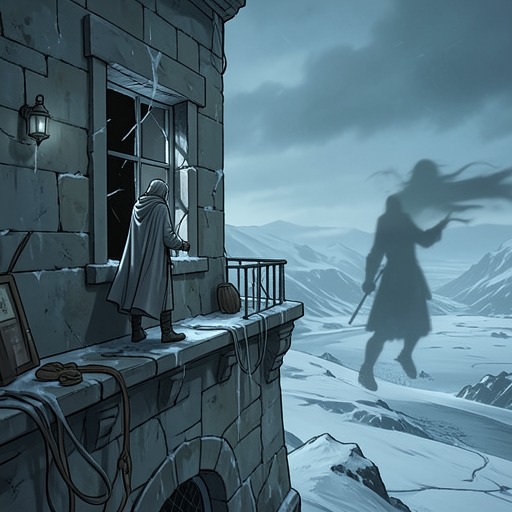
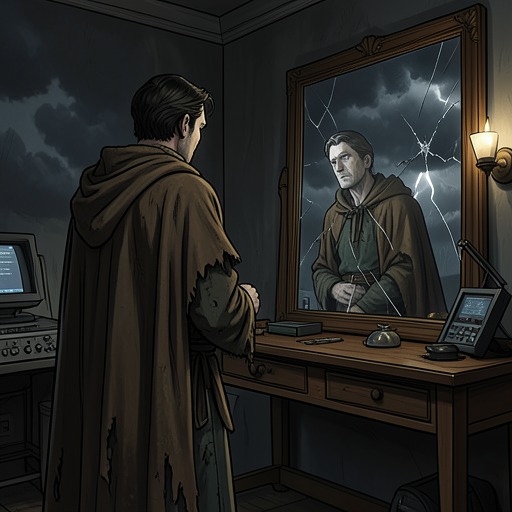
Theon Greyjoy's raid on the Stony Shore
A Clash of KingsTheon Greyjoy's raid on the Stony Shore is the first overt act of the Greyjoy invasion of the North that Theon personally commands. Planned as a surprise attack on a sleeping coastal settlement, it converts a small fishing village into a demonstration of ironborn power: the village is burned, its men are killed or driven away, women are taken as salt wives, and other survivors are raped, killed, or enslaved. The raid advances Lord Balon Greyjoy's wider strategy while exposing Theon's insecurity, his dependence on the Old Way's violence, and the widening breach between the identity he performs and the judgment he cannot entirely silence.
Strategic Background
Theon returns to the Iron Islands after years away, having once been taken from Pyke as a ward of Eddard Stark. He remembers leaving his father’s castle aboard Robert Baratheon’s war galley and now longs to see Pyke grow larger before him from the sea. That desire for home is immediately entangled with political ambition: Lord Balon’s rebellion had sought to restore the Old Way, but Robert Baratheon, aided by Eddard Stark, crushed it. With both men dead and the realm divided among youthful rulers, Theon believes the moment has come for a renewed ironborn offensive.
The Old Way provides the raid with its ideological language. In Theon’s understanding of ironborn history, war and reaving were the proper trades of the islanders, while mining, farming, and tending animals belonged to captives. Aegon the Dragon ended that order by burning Black Harren, returning Harren’s kingdom to the rivermen, and reducing the Iron Islands to a marginal part of a larger realm. The old stories nevertheless remain alive around driftwood fires and in the halls of Pyke, while the Greyjoy words, “We Do Not Sow,” define an identity founded on taking rather than producing.
The raid is therefore more than a search for plunder. Theon thinks that Lord Balon staged his rebellion for the restoration of the Old Way rather than merely for the vanity of wearing a crown, and he imagines that his own success will surpass his father’s failure. He is the last-born son who was once a hostage, yet he sees himself as the man capable of making the Greyjoy vision real. The attack on the Stony Shore is designed to serve that ambition without revealing the full invasion: the northmen are meant to interpret the violence as ordinary raiding until the larger blows fall on Deepwood Motte and Moat Cailin.
The Attack on the Village
Theon planned the assault with deliberate surprise. His ships came ashore in the chill darkness before dawn, and he leapt from the prow with a longaxe in hand to lead his men into the sleeping village. The attack was not an accidental outbreak of violence or an uncontrolled skirmish; it was an operation Theon had conceived and personally directed. He did not like what the plan required, but he framed that reluctance as irrelevant beside the demands of command and the need to prove himself.
The village’s defenders had little chance. Earlier, Tallhart men had approached joking and singing beneath the three trees of House Tallhart, with rabbitskins hanging from their lances. Archers hidden behind gorse broke that confidence with a rain of arrows, after which Theon led his men-at-arms into the survivors with daggers, axes, and warhammers. He ordered the leader spared for questioning, only to discover that the captive was Benfred Tallhart, a man Theon had known during a visit by Eddard Stark to Torrhen’s Square.
Benfred’s capture turns the raid from impersonal violence into a confrontation with Theon’s former life. Benfred curses him as a turncloak and invokes Robb Stark’s revenge, threatening that Robb will gut Theon and feed his heart to his wolf. Aeron Damphair responds that Benfred must be killed, while Theon insists that he has questions first. The exchange briefly places inquiry, memory, and political calculation against ritual violence. In the end, Benfred is dragged toward the shore, where Aeron’s followers intend to drown him in salt water according to the Old Way.
The scene’s battlefield aftermath makes the operation’s character unmistakable. Theon hears the rough sounds of victory but judges the encounter scarcely worthy of the name of battle, comparing it to the slaughter of sheep in steel. His men gather usable horses, kill those too badly wounded to save, and loot the dead. Gevin Harlaw cuts a finger from a corpse to take a ring, explicitly treating the act as paying the iron price. Theon considers searching the men he killed for jewelry, yet the thought leaves a bitter taste in him, and the imagined judgment of Eddard Stark returns even as Theon angrily tells himself that Stark is dead and means nothing to him.
Civilian Destruction and the Old Way
By the time Theon returns to the Sea Bitch, Benfred’s limp body is being dragged from the surf. The fishing village has ceased to exist as a community: nothing remains except cold ashes that stink when rain falls. The men have been put to the sword apart from a handful deliberately allowed to flee and carry news to Torrhen’s Square. Their escape is part of the strategy, since fear and rumor will announce danger while still disguising the scale of the Greyjoy campaign.
The women and girls are divided according to age, appearance, and perceived usefulness. Those young and fair enough are claimed as salt wives. Older or less attractive women are raped and killed, while some are taken as thralls when their skills seem useful and they are judged unlikely to cause trouble. The raid thus imposes not only death but a forced social order: sexual possession, enslavement, and selective survival become instruments through which the attackers reproduce the hierarchy Theon associates with ironborn conquest.
Theon’s private response is conflicted rather than exculpatory. He does not mistake the devastation for a clean victory, and he recognizes the ugliness of what has been done. Yet he continues to act, because abandoning the attack would threaten his standing among the ironborn and his place in Lord Balon’s plans. The raid exposes the distance between the Old Way as a heroic ancestral legend and the Old Way as lived practice: beneath the banners and songs are burned homes, mutilated bodies, coerced relationships, and people reduced to property or labor.
Political Purpose and Personal Rivalry
Theon has taken care to ensure that the victory is credited to him. He assigns Dagmer Cleftjaw to guard the ships, because otherwise men might call the success Dagmer’s rather than Theon’s. Dagmer, less prickly and more secure than Theon, merely laughs at the slight. The contrast reveals how anxiously Theon measures every action against the possibility of being overshadowed by an older, more respected ironborn warrior.
His rivalry with Asha Greyjoy intensifies that anxiety. Asha is sailing the Black Wind north and is expected to win a castle of her own, while Theon fears that Lord Balon will make songs for her and forget the son who carried out the bloody work along the coast. The raid is consequently both a military maneuver and a bid for recognition within the Greyjoy family. Theon wants the attack to conceal the invasion from the northmen, but he also wants it remembered as his achievement.
The event’s larger military value lies in its place within a coordinated campaign. Theon’s violence on the Stony Shore is meant to look like the work of sea raiders seeking plunder, while the true threat approaches elsewhere. The planned attacks on Deepwood Motte and Moat Cailin make the fishing village a diversion and an advance signal at once. Its destruction demonstrates that the Greyjoys can strike the coast, while the limited release of survivors ensures that the news travels toward Torrhen’s Square.
Consequences and Narrative Significance
The immediate consequence is the transformation of the Stony Shore from inhabited coast to ash-strewn military frontier. The attackers gain shipside plunder, captives, and information, but the human cost is borne almost entirely by people with no power to shape the war. The raid’s violence is therefore not incidental background to the conflict between kings; it is one of the means by which that conflict reaches ordinary settlements.
The raid also deepens Theon’s divided identity. He has returned to claim the Iron Islands and prove that he belongs among the ironborn, yet his memories of Eddard Stark and his familiarity with Benfred prevent the victims from remaining wholly abstract. His anger at those memories does not erase them. Instead, the attack makes belonging itself violent: to be accepted as Balon’s son and an ironborn commander, Theon must enact customs that his former life has taught him to recognize as cruel.
Placed beside the wider war, the raid belongs to a pattern in which military planning and civilian suffering are inseparable. Armies maneuver around castles, fleets organize into lines of battle, and commanders speak of secrecy and objectives, but the operational logic is repeatedly realized through burned villages, dead animals, enslaved people, and terrified survivors. The Stony Shore attack gives that logic a concentrated form. Its decisive result is not the capture of a famous stronghold but the revelation of what Theon’s chosen restoration requires him to become.